
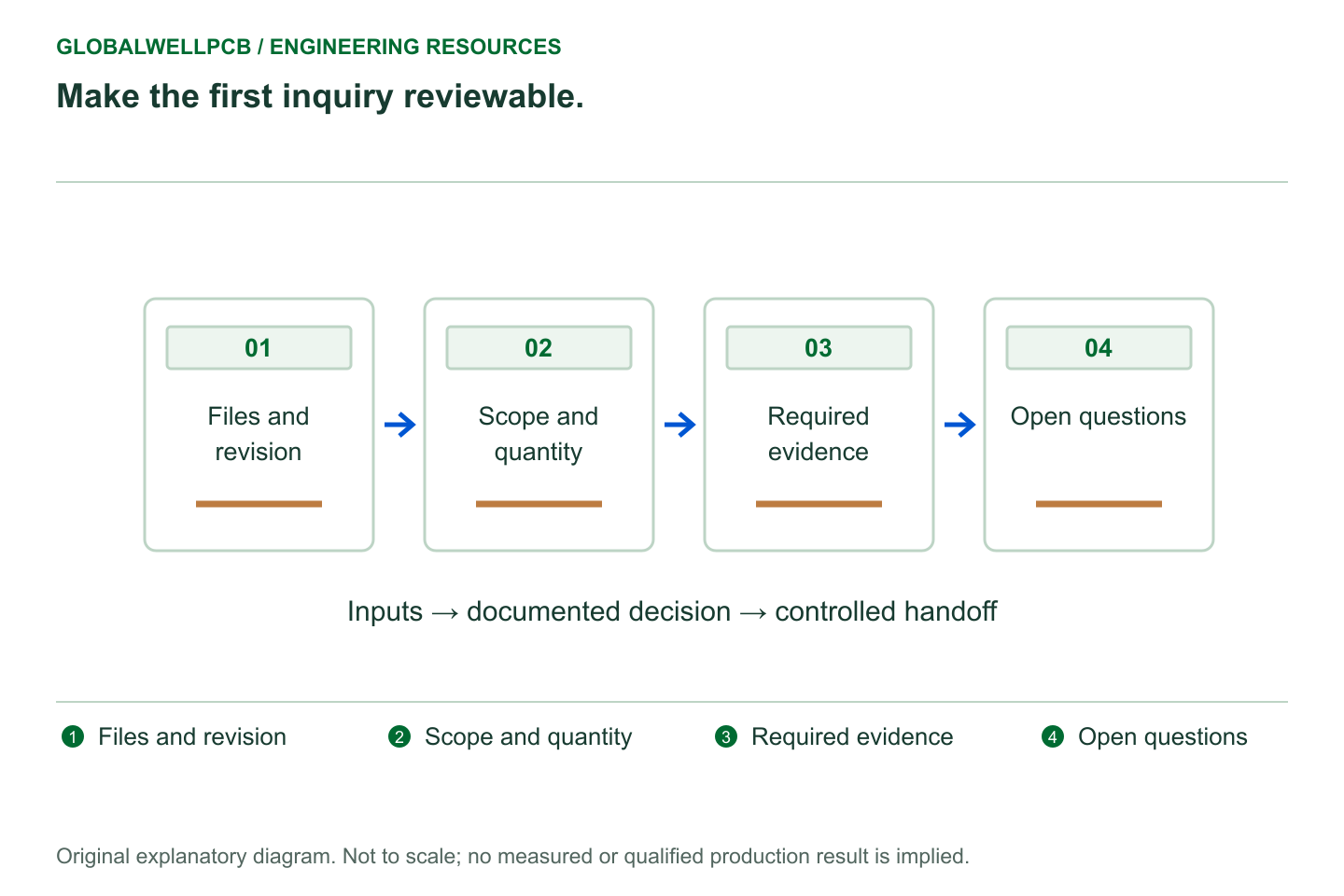
A useful PCB request for quotation gives the fabricator one identifiable board revision, its manufacturing data, and the requirements that the files cannot explain on their own. The aim is to make the proposed build and the remaining decisions visible before a price becomes a production commitment. A ZIP containing artwork is a starting point; the quote package also needs a clear specification, order scope, and route for resolving questions.
This guide addresses bare-board procurement. When assembly is included, add the assembly inputs as a separately identified scope so that a fabrication quotation is not mistaken for a complete PCBA offer.
Define what the supplier is being asked to quote
Start the request with the board identifier, revision, requested quantities, and supply boundary. Say whether quantities mean individual circuits or assembled arrays. Identify engineering samples, a repeat build, or a design still being evaluated. These labels describe the intended review; they do not establish that a design is production ready.
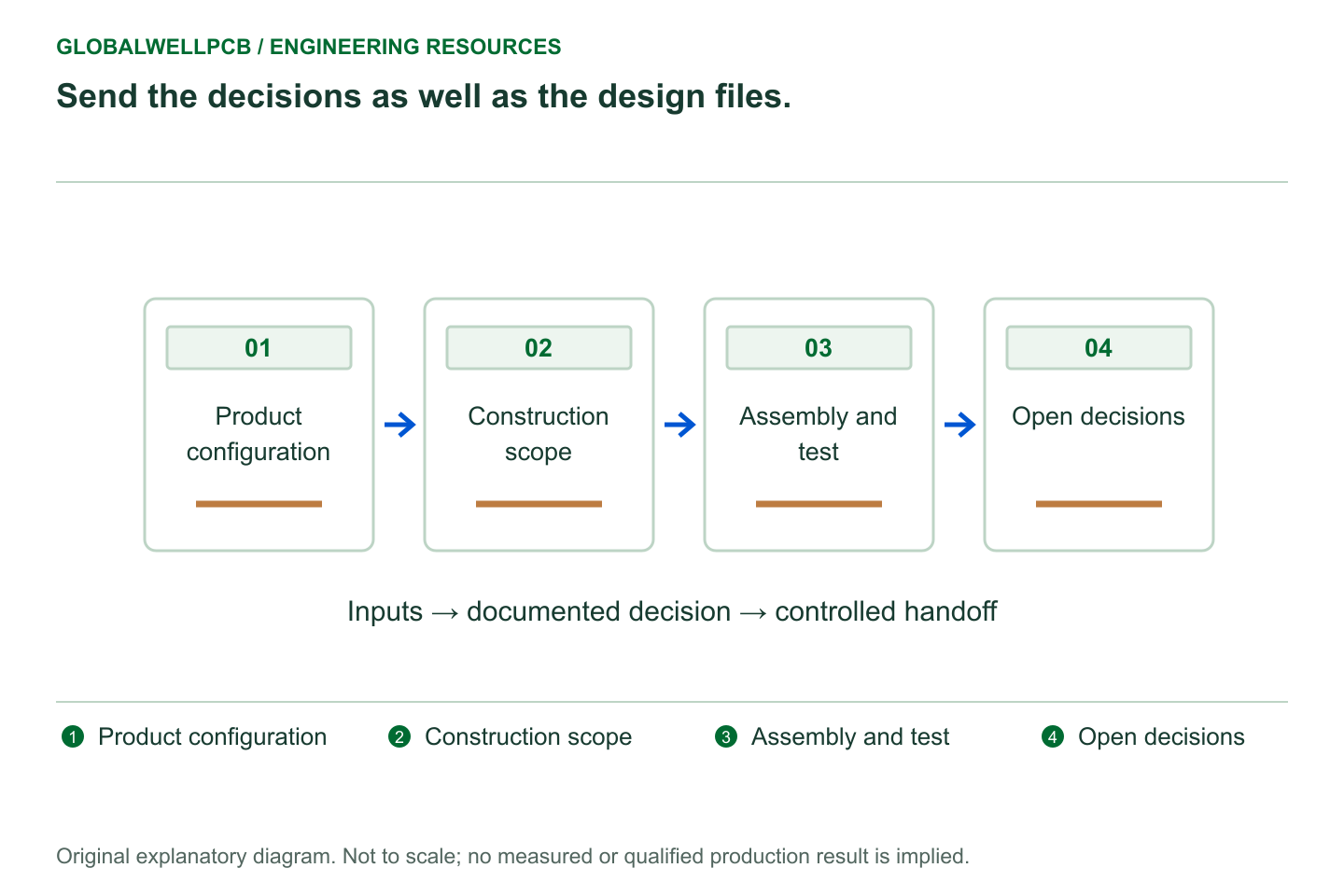
Keep required dates separate from a supplier’s confirmed schedule. Likewise, list a requested delivery destination and packaging condition without assuming that freight, duties, qualification work, or special documentation are included. A supplier should be able to state exceptions against an explicit request.
If the design is provisional, name the open issues. For example, the material might be selected while the final dielectric construction is awaiting agreement. Ask for a conditional quotation that identifies the proposed construction. Silently presenting provisional files as released files makes it difficult to determine which later change caused a price or process revision.
Give manufacturing data a controlled identity
Create the quote package from a saved design state and give the archive a unique release identifier. Include a short file index mapping each file to its purpose. The recipient should not need to infer the inner-layer order from file timestamps or guess which of two outlines is current.
Ucamco distinguishes Gerber image data from board-level fabrication documentation such as materials, finish, and thickness. Its Gerber Job format can carry that additional information, but implementations may be partial. Confirm which data the recipient actually reads. Ucamco: Gerber Job
Choose a manufacturing format accepted by the supplier. If providing more than one representation, identify the controlling dataset and ask for discrepancies to be reported. Do not invite the supplier to combine whichever features appear convenient from different exports. A native CAD file can be useful for review, but its presence does not explain whether it supersedes the released manufacturing outputs.
An archive checksum is a useful proposed document-control measure: it identifies the transmitted archive without claiming that the design inside is correct. Record the checksum with the enquiry and any later approval so that commercial and engineering discussions refer to the same package.
Use a requirement-to-evidence map
The following is a proposed RFQ worksheet. Its purpose is to expose unanswered questions, rather than prescribe one universal manufacturing specification.
| Requirement | Put this in the package | Ask the supplier to return |
|---|---|---|
| Board identity | Part number, revision, file index, controlling dataset | Exact quoted revision and unresolved discrepancies |
| Layer construction | Layer order, proposed stackup, material designation, finished thickness requirement | Offered construction and any substituted material |
| Copper | Layer-specific starting or finished copper requirements, clearly labeled | Interpretation of the copper requirement and relevant exceptions |
| Holes and features | Drill data, plating identification, slots, cutouts, special via treatments | Features needing a process change or clarification |
| Electrical requirements | Applicable impedance structures, test requirements, acceptance documents | Proposed verification scope and supplied records |
| Mechanical interfaces | Dimensioned drawing, critical tolerances, edge features | Any excluded or unachievable requirement |
| Order scope | Quantities, individual board or array, documentation and packaging | Included deliverables, assumptions, and commercial exclusions |
Use this worksheet as an index into actual files. Writing “see drawing” is useful only when the drawing identifier and revision are unambiguous. If a requirement occurs in several places, check that the values agree before sending the package.
Explain the holes and mechanical features
Separate hole information from board-outline information. Identify plated and non-plated features, the intended layer spans for non-through connections, and any special finishing needed at pads. A drill size in an export must not be casually relabeled as a guaranteed finished-hole dimension.
Include a dimensioned drawing for features that matter to mating parts, enclosures, or subsequent assembly. If a connector fit depends on a plated slot, identify that slot and the finished condition. A rendered board image can help a reviewer understand the design, but it is a weak place to define an acceptance dimension.
Altium’s fabrication-output documentation treats Gerber and NC Drill as separate outputs and calls for consistent export settings. This supports checking the datasets together rather than treating a successful artwork export as evidence that drilling information is complete. Altium: Preparing Fabrication Data
For complex vias, provide a layer-span table or cross-section. “HDI” and “via-in-pad” are descriptions too broad to resolve every process choice. Ask the fabricator to identify the proposed interconnect sequence and any assumptions before layout changes are approved.
Separate fixed requirements from allowed proposals
A quotation becomes easier to evaluate when the supplier can distinguish a mandatory requirement from an engineering preference. Mark the exact laminate as mandatory if qualification or electrical modeling depends on it. If alternatives are allowed, define the approval process and the properties that require comparison.
Avoid “equivalent material acceptable” without explaining equivalent for which function. A proposed change may preserve a nominal thickness while changing the electrical model or assembly behavior. Request the alternative’s exact designation, source document, offered construction, and reason for the proposal.
Use the same discipline for panelization and controlled impedance. State whether the supplier may propose an array or trace-width adjustment, and who must approve it. A suggested manufacturing adjustment should return as a drawing or marked change list that the design owner can review, rather than remain an undocumented note in a quotation.
Close engineering questions before placing the order
Consider a hypothetical enquiry in which the drawing names one material, the stackup names another, and the quote says only “FR-4.” There is no sound price comparison until the material interpretation is resolved. The useful next action is a written construction confirmation, not a general request for a discount.
Maintain a short question log with an owner, proposed answer, affected file, and disposition. If an answer changes the design, reissue the package. If it clarifies an existing requirement, attach the clarification to the controlled enquiry. In either case, make the accepted answer visible to the person releasing the purchase order.
Before ordering, check that the quotation names the accepted revision, construction, verification scope, and exceptions. A clean commercial quotation can still rest on a different engineering assumption. Treat the approved file package and the accepted technical response as a connected record.
The final handoff should let a new reviewer answer three questions without searching old messages: what board is being purchased, what the supplier agreed to make, and which questions remain open. That is the practical test of an effective PCB RFQ package.
References and method
This article uses AI-assisted drafting and document review of the public Ucamco overview and Altium fabrication-output guidance linked above. The worksheet and approval sequence are proposed review tools, not results from a production trial. The required process limits, acceptance criteria, and supplier commitments must be agreed for the actual board.